
ROD challenge protocol (version 1)
ROD = Roseovarius Oyster Disease
Protocol for an Roseovarius Oyster Disease (Juvenile Oyster Disease) Challenge using Juvenile Oysters Exposed to Diel-cycling Hypoxia and Acidification This document incorporates portions of Katrina (Kat) Kulesh’s protocol from the Summer of 2022. The sections copied from Kat’s protocol are denoted with a “KK”.
Pathogen Preparation - KK
- Streak a known glycerol stock of Aliiroseovarius crassostreae CV919-312 (formerly called Roseovarius crassostreae CV919-312) on a marine agar plate and incubate
- Add a colony to a 10 mL mYP30 or SWT broth in a 50 mL Falcon tube and incubate with a loosely screwed on cap and agitation
- Perform a DNA extraction, then a gel electrophoresis to confirm presence of DNA
- Perform a PCR on the extracted DNA with both forward and reverse primers,, then a gel electrophoresis using a 1kB ladder (100 mb ladder if can’t find 1kB)
- Used JOD primers 1339F and 115R
- Use a negative control with no DNA and only nuclease-free water Find more details on primers, and bands given from gels in cited paper *Maloy, A. P., & Miller, K. B. (2008). Localisation of the bacterial agent of juvenile oyster disease (Roseovarius crassostreae) within affected Eastern oyster (Crassostrea virginica). Journal of Invertebrate Pathology, 97, 150-158.
Set up: Two Days in Advance - KK
- Prepare 15 mL of broth per container one or two days before adding ROD to oysters
- Prepare set-up in incubator fridge with non-ROD and ROD containers separated by hanging piece of plastic
- Have each container aerated with disinfected air stones and airlines
- *Be sure aerators work!
- Divide juveniles amongst replicate baskets by dry weight
- Dry with kimwipes or something and measure using scale
- Add oysters to mesh baskets! - They will acclimate for ~48 hours before the beginning of the challenge
- Add to the Puritz lab’s mesh baskets and place in bowls filled 0.650 L
- Careful to not let aerators drydock the oysters, don’t place aerators immediately underneath baskets
- Feeding: Either mix Reed Mariculture Shellfish Diet in with water to fill bowls or separately dilute and add to bowls
- Feed daily at similar times if do-able
- Water changes: Daily 50% (subject to change depending on juveniles’ feeding habits)
- Use a toothbrush or dedicated bristle column brush per treatment to clean sides of container and mesh basket of algae BEFORE changing water
- It’s good to periodically shift oysters around in their baskets
- ***You do NOT need to turn on the incubator- the heat produced from running the aerators keeps it at a consistent 22C when the door is propped open!!!!!!!!!!!!!!!!!!!!
- Keep a thermostat inside the incubator just in case to be sure it remains at room temperature over the acclimation and experimental period.
Day of Innoculation - KK
Pathogen Prep
I didn’t do this last time, but this could be at Marta’s discretion
- Centrifuge CV broths at room temperature for 10 mins at 3000 rpm
- Remove supernatant broth
- Resuspend in the same amount of FSSW as removed supernatant (or less maybe)
-
THEN, go forth with checking OD and spot plating using this FSSW-resuspended CV broth
- Check OD of CV in triplicate and use RE22 OD600 calculations page to quantify approximate CFUs/mL
- Calculate to have concentration of 1*105 CFU/mL CV in challenge containers
- This spreadsheet Marta made for OD600-to-CFU calculations is wonderful
- Make sure to use your supernatatn as a blank in triplicate too (either FSSW or mYP30)
- Spot Plate CV for More Accurate Counts
- Split an mYP30 plate in thirds, labeled 4, 5, 6 for CV dilutions
- Dilute CV 1:10 where 0 is undiluted and 1 is 100ul CV with 900 ul FSSW
- 2 is 100ul from dilution 1 and 900ul FSSW and so forth
- Mix and add 10ul spots in triplicate to the mYP30 plate
- 3 x 10ul spots for the 4th dilution
- 3 x 10ul spots for the 5th dilution
- 3 x 10ul spots for the 6th dilution
- Place in incubator overnight and count spots at every quantifiable dilution the day or two following making the spot plate
Juvenile prep
- Scrub, water change, and feed oysters
- *Feed as close to the beginning of the challenge as possible
- Initial (pre-challenge) genomic sampling
Innoculation
- Add CV at quantified volume to reach a concentration in the ROD-treatment containers of 1*10^5 CFU/mL
- Record time CV was added
Innoculation Notes from 20230825:
- Stock OD: 0.548
- CFU/mL of Stock: 6.58*10^8
- Amount of Stock Added to each container: 10mL
- Time Stock Was Added: 3:00PM
PCR on 20230906 confirmed that we did inoculate with ROD.
Experimental maintenence
- Aim for oyster exposure to CV for ~12 hours before first water change/feeding
- 1/2 water changes + feeding every day & full water changes on Fridays to avoid weekend water change
- Mortality estimates on MWF
Maintenance schedule
| Day | Date | Tasks | Person |
|---|---|---|---|
| T | 8/29/23 | 1/2 water change | Shannon |
| W | 8/30/23 | mort & 1/2 water change | Shannon |
| Th | 8/31/23 | 1/2 water change | Shannon |
| F | 9/1/23 | mort & full water change | Shannon |
| Sa | 9/2/23 | no maintenance* | - |
| Su | 9/3/23 | quick mort & full water change | Caitlin |
| M | 9/4/23 | Holiday - no maintenance* | - |
| T | 9/5/23 | mort & 1/2 water change | Caitlin |
| W | 9/6/23 | mort & 1/2 water change | Shannon |
| Th | 9/7/23 | 1/2 water change | Shannon |
| F | 9/8/23 | mort & full water change | Shannon |
| Sa | 9/9/23 | no maintenance* | - |
| Su | 9/10/23 | no maintenance* | - |
| M | 9/11/23 | mort & 1/2 water change | Shannon |
*if we are not anywhere near 40-50%, no maintenance or mort count needed
Schedule is subject to change based on how mortality is progressing.
Water change protocol
Notes:
- Start with control group to avoid contamination
- change gloves in between treatment groups (CON/ROD)
- Ethanol gloves and surfaces to avoid contamination, but ensure it is dry before handling juveniles
- Rinse containers and tools with ASW before using them
Materials needed:
- Artificial Seawater (ASW, 28-30ppt)
- Shellfish Diet (SD)
- 70% ETOH in spray bottle
- beakers
- green trays - for transporting cups
- ASW squirt bottles
- new clean baskets (if needed)
Procedure:
- Ethanol bench and trays and wipe dry with paper towels.
- Make ASW+SD. Dilute 1.5ml of SD into 3.2L of ASW (for a full water change make up 3 3.2L jars like this)
- Turn off airstones before moving any baskets, to avoid contamination via aerosols
- Remove cups for water change - start with control cups
- Remove basket and place it in it’s treatment-specific red bin.
- Into the “OLD WATER” beaker, pour out either 1/2 the volume or the full volume (depending upon if you’re doing a 1/2 or full water change).
- Attempt to rinse out the built up algae and poop from the basket- if possible. Tilting the basket will help to separate oysters from debris.
- If baskets need to be changed, rinse juveniles into new labeled basket with ASW squirt bottle. The red bins can be used to catch seawater.
- Top off the cup with ASW + SD (measured in the “NEW WATER” beaker) for a total volume of ~650ml.
- Return basket to it’s cup and place back in the incubator with airstone.
- Turn on airstones after all water changes are complete.
- Dispose of ROD water – ask Marta!
- Dry, bleach, and ethanol the benchtop.
- Bleach all glassware, bins, caps, squirt bottles, baskets, etc. following the Puritz Lab bleaching protocol (see below).
- Set glassware and other materials to dry on the drying pad.
- Double check the air bubbles and make sure the incubator is propped open before leaving for the day.
- Check ASW stock, bleach, and sodium thio and text Megan if any needed to be replenished.
- Record water change and any notes in lab notebook (located on Puritz Lab bench).
Bleaching protocol
Materials needed:
- bleach
- sodium thiosulfate
- water
- DI
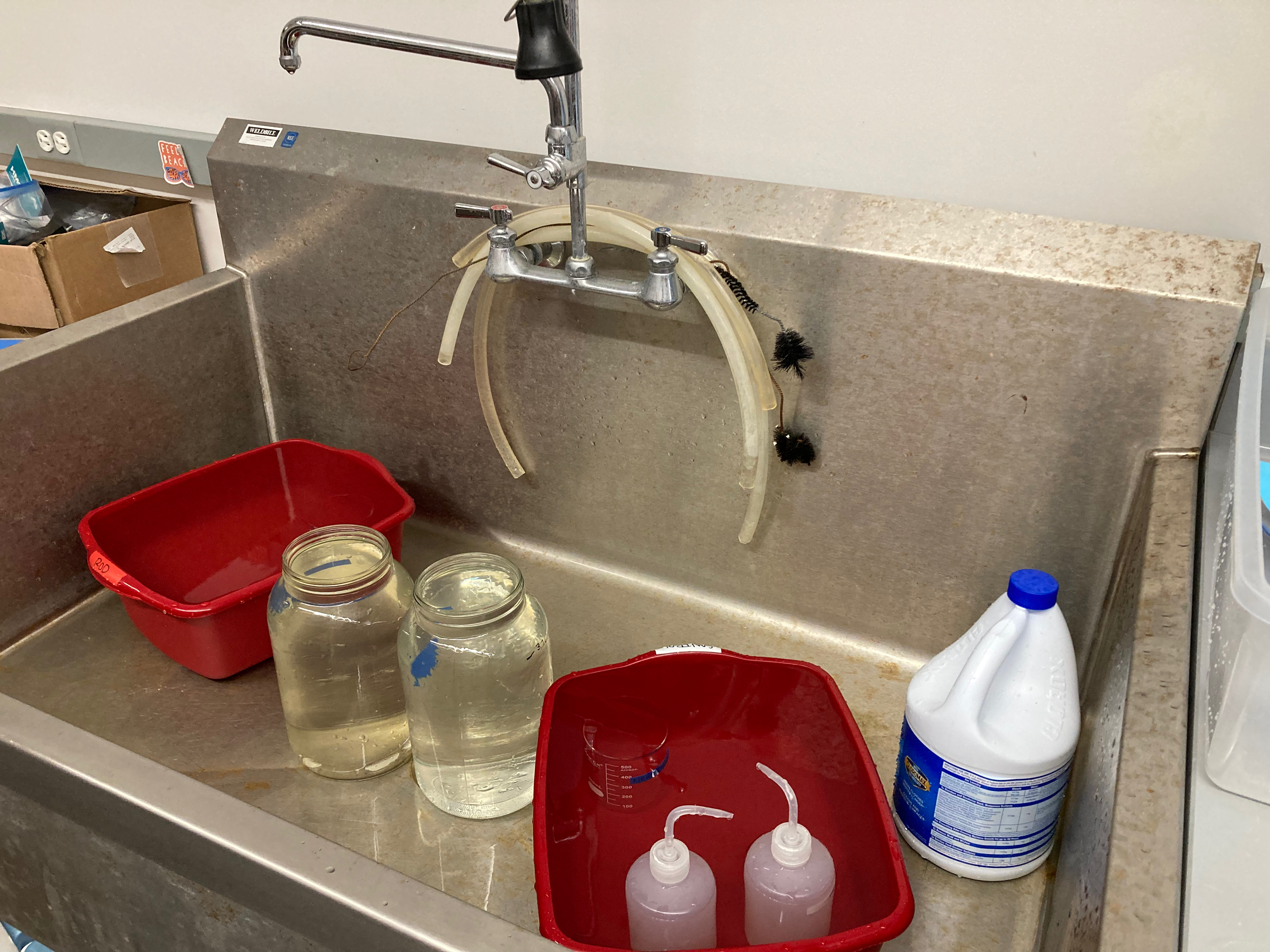
Procedure:
- Bleach with dilute bleach solution (a quick pour of bleach + water should be good). Be sure to bleach the outside of jars/beakers too with 10% bleach squirt bottle (on Puritz bench).
- Let sit for at least 15mins
- Pour out bleach
- Neutralize remaining bleach with sodium thiosulfate crystals dissolved in water (pour some crystals into each container and add hot water & mix)
- Rinse everything very, very well 5-6x in hot water
- Rinse in DI water
Mortality estimates
Materials needed:
- Magnifying glass or dissecting scope
- Petri dishes
- tweezers or paint brush
- counters
Note: This dissecting scope works really great!
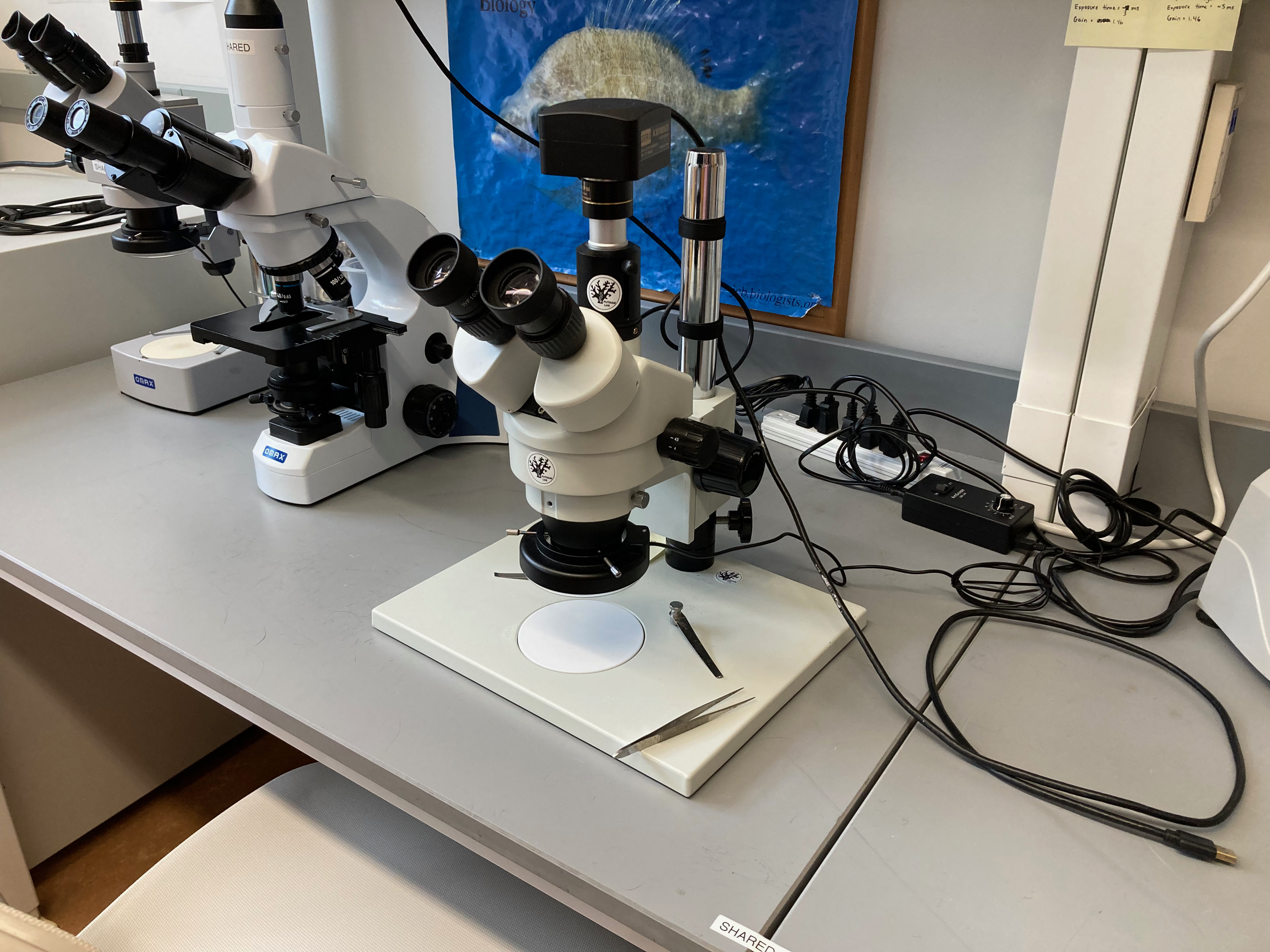
Procedure:
- Transfer ~50 oysters to their treatment-specific dish
- Under magnification, assess whether the first 50 you see (at random) are alive or dead keeping count with counters
- living oysters will be closed and have some color to them
- dead oysters can look gapped open, often have no color, and sometimes they float a little
- Record alive/dead counts in notebook
- Perform for 1-2 baskets per treatment group
- Update Megan with % mortality estimates for the day (we are aiming to get 60-70%)
- Dishes can be wiped out with a kim wipe – do the control dishes first to avoid contamination!
Final mortality counts and sampling
check back later!